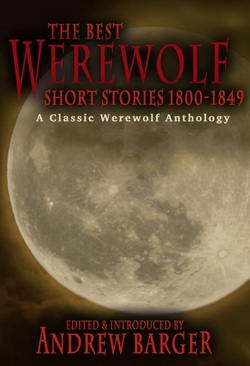
 Best Werewolf Short Stories
|
E-book

|
Transformation of the werewolf in literature made its greatest strides in the 19th century when the shape-shifting monster leaped from poetry to the short story. It happened when this shorter form of literature was morphing into darker shapes thanks in no small part to Edgar Allan Poe, Honoré de Balzac, E. T. A. Hoffmann, Nathaniel Hawthorne, Prosper Mérimée, James Hogg, and so many others in Europe and the United States.
The fifty year period between 1800 and 1849 is truly the cradle of all werewolf short stories. For the first time in one anthology, Andrew Barger, award winning author of The Best Horror Short Stories 1800-1849, has collected the best werewolf stories from this period. Both "The Man-Wolf" and "A Story of a Weir-Wolf" were published for the first time in over 150 years.
*1831 The Man-Wolf - Leitch Ritche (1800-1865)
*1846 A Story of a Weir-Wolf - Catherine Crowe (1790-1872)
*1828 The Wehr-Wolf: A Legend of the Limousin - Richard Thomson (1794-1865)
*1839 The White Wolf of the Hartz Mountains - Captain Frederick Marryat (1792-1848)
*1838 Hugues the Wer-Wolf: A Kentish Legend of the Middle Ages - Sutherland Menzies [Mrs. Elizabeth Stone] (1806-1883)
The fifty year period between 1800 and 1849 is truly the cradle of all werewolf short stories. For the first time in one anthology, Andrew Barger, award winning author of The Best Horror Short Stories 1800-1849, has collected the best werewolf stories from this period. Both "The Man-Wolf" and "A Story of a Weir-Wolf" were published for the first time in over 150 years.
*1831 The Man-Wolf - Leitch Ritche (1800-1865)
*1846 A Story of a Weir-Wolf - Catherine Crowe (1790-1872)
*1828 The Wehr-Wolf: A Legend of the Limousin - Richard Thomson (1794-1865)
*1839 The White Wolf of the Hartz Mountains - Captain Frederick Marryat (1792-1848)
*1838 Hugues the Wer-Wolf: A Kentish Legend of the Middle Ages - Sutherland Menzies [Mrs. Elizabeth Stone] (1806-1883)
Reviews
WEREWOLFNEWS.COM: Barger's enthusiasm for the material is evident on every page: the commentary and the depth of the research which informs it . . .. I think this is a great little book, and you’ll probably feel the same way if you agree that reading and knowledge are awesome. The five stories in this anthology contain the seeds of werewolf myths we accept (and in some cases defend) . . ..
Midwest Book Review: After an informed and informative introduction on the subject by Andrew Barger, five of these stories are presented in full, followed by a listing of short stories considered from 1800 to 1849, along with an index of Real Names. A seminal work of impressive scholarship, The Best Werewolf Short Stories 1800-1849: A Classic Werewolf Anthology is highly recommended reading for fantasy fans, and a valued addition to academic library Literary Studies reference collections.
Werewolves.com: Andrew Barger has put together a collection of werewolf short stories penned from 1800-1849, some of which haven’t been published in over 150 years. But that’s not all, not only does this book contain stories on our favorite supernatural creatures, but Andrew Barger also filled it with amazingly well researched information on werewolves and history.
Midwest Book Review: After an informed and informative introduction on the subject by Andrew Barger, five of these stories are presented in full, followed by a listing of short stories considered from 1800 to 1849, along with an index of Real Names. A seminal work of impressive scholarship, The Best Werewolf Short Stories 1800-1849: A Classic Werewolf Anthology is highly recommended reading for fantasy fans, and a valued addition to academic library Literary Studies reference collections.
Werewolves.com: Andrew Barger has put together a collection of werewolf short stories penned from 1800-1849, some of which haven’t been published in over 150 years. But that’s not all, not only does this book contain stories on our favorite supernatural creatures, but Andrew Barger also filled it with amazingly well researched information on werewolves and history.
Interview with Andrew Barger
Q1: Okay Andrew, why did you decide to edit a book of the best werewolf short stories from 1800-1849?
A1: I have never seen one that addresses a 50 year time period, especially this time period. I try to fill in the gaps in the literature when I find them. This is when werewolf short stories were in their infancy, yet the stories are very good. Plus, I was feeling a tad beastly.
Q2: Were there many werewolf short stories written before 1800?
A2: I have been unable to find any. Shapeshifters in the literature go as far back as the ancient Romans and Greeks. They moved forward through poetry and jumped to the short story form in the early nineteenth century.
Q3: How do the werewolf stories of 1800-1849 compare to today's werewolf stories?
A3: They are not as graphic and some of the stories lack deep character development. Since werewolf short stories were an entirely new form of writing in this period, this is to be expected.
Q4: Did you include any werewolf stories that have not been collected in an anthology before?
A4: I did. "The Man Wolf" by Leitch Ritchie and "A Story of a Weir-Wolf" by Catherine Crowe.
Q5: Which of the werewolf stories is your favorite?
A5: "The White Wolf of the Hartz Mountains" by Captain Frederick Marryat.
Q6 : Can you give us a list of the stories contained in the book?
A6 : Sure. "Hugues the Wer-Wolf: A Kentish Legend of the Middle Ages," "The Man-Wolf," "A Story of a Weir-Wolf," "The Wehr-Wolf: A Legend of the Limousin," and "The White Wolf of the Hartz Mountains."
Q7: Edgar Allan Poe wrote his short stories during this time period. Did he write any werewolf short stories?
A7: Not one, but he did have a furry cat named Caterina. (Laughs)
Q8: You also annotated and edited The Horror Short Stories 1800-1849 - The Best Ghost Stories 1800-1849 and The Best Vampire Stories 1800-1849. How does the werewolf genre compare for this period as far as robustness of stories?
A8: The genre is not as developed as the ghost and horror stories for the first half of the nineteenth century, but they are enjoyable stories nonetheless. The period in review is really the cradle of the werewolf short story genre, in my mind. It's were it all began.
Interesting Werewolf Short Story Trivia
Who was the first female to write a werewolf short story in the English language?
In researching my anthology Shifters: The Best Werewolf Short Stories 1800-1849 I uncovered a tale by Catherine Crowe (1790-1872). She called it "A Story of a Weir-Wolf" and published it in 1846. Despite the rather boring title, it's a fine lycan tale. At first she appears to be the first woman to write a werewolf story in the English language, but then I remembered that "Hugues the Wer-Wolf: A Kentish Legend of the Middle Ages" was attributed to Sutherland Menzies (1806-1883). That tale was published eight years before Crowe's story in 1838. There are some who believe Menzies was a pen-name for Mrs. Elizabeth Stone. If so, she was the first woman to pen a werewolf short story.
Did Edgar Allan Poe Write a Werewolf Story?
Edgar Allan Poe (1809-1849) wrote scary stories in a number of supernatural genres. He did not invent the horror short story, but he took it to unbelievable heights. He was the first to invent a closed room murder mystery (The Murders in the Rue Morgue of 1841) and a founding father of science fiction short stories. Poe also was the first to take us inside the head of a crazy man in "The Tell-Tale Heart" of 1843.
Yet, Edgar Allan Poe failed to cover a few crucial genres in his short stories. For instance, he did not write a vampire or monster story. I have blogged on why I believe Poe did not write a vampire story in the past. That is unfortunate as I am convinced that no one could have written a vampire story like Poe. What's more, zombie's had not been created in Poe's time. Unfortunately, Poe also did not write a werewolf story. Below is a list of werewolf stories originally published in the English language during Poe's lifetime, which he may have read. They are found in The Best Werewolf Short Stories 1800-1849:
1831 The Man-Wolf by Leitch Ritche (1800-1865)
1846 A Story of a Weir-Wolf by Catherine Crowe (1790-1872)
1828 The Wehr-Wolf: A Legend of the Limousin by Richard Thomson (1794-1865)
1839 The White Wolf of the Hartz Mountains by Captain Frederick Marryat (1792-1848)
1838 Hugues the Wer-Wolf: A Kentish Legend of the Middle Ages by Sutherland Menzies [Mrs. Elizabeth Stone] (1806-1883)
#WerewolfStories #BestWerewolfStories #LycanStories #VintageWerewolf #WerewolfTales #VictorianWerewolfStories #PoeWerewolfStory
In researching my anthology Shifters: The Best Werewolf Short Stories 1800-1849 I uncovered a tale by Catherine Crowe (1790-1872). She called it "A Story of a Weir-Wolf" and published it in 1846. Despite the rather boring title, it's a fine lycan tale. At first she appears to be the first woman to write a werewolf story in the English language, but then I remembered that "Hugues the Wer-Wolf: A Kentish Legend of the Middle Ages" was attributed to Sutherland Menzies (1806-1883). That tale was published eight years before Crowe's story in 1838. There are some who believe Menzies was a pen-name for Mrs. Elizabeth Stone. If so, she was the first woman to pen a werewolf short story.
Did Edgar Allan Poe Write a Werewolf Story?
Edgar Allan Poe (1809-1849) wrote scary stories in a number of supernatural genres. He did not invent the horror short story, but he took it to unbelievable heights. He was the first to invent a closed room murder mystery (The Murders in the Rue Morgue of 1841) and a founding father of science fiction short stories. Poe also was the first to take us inside the head of a crazy man in "The Tell-Tale Heart" of 1843.
Yet, Edgar Allan Poe failed to cover a few crucial genres in his short stories. For instance, he did not write a vampire or monster story. I have blogged on why I believe Poe did not write a vampire story in the past. That is unfortunate as I am convinced that no one could have written a vampire story like Poe. What's more, zombie's had not been created in Poe's time. Unfortunately, Poe also did not write a werewolf story. Below is a list of werewolf stories originally published in the English language during Poe's lifetime, which he may have read. They are found in The Best Werewolf Short Stories 1800-1849:
1831 The Man-Wolf by Leitch Ritche (1800-1865)
1846 A Story of a Weir-Wolf by Catherine Crowe (1790-1872)
1828 The Wehr-Wolf: A Legend of the Limousin by Richard Thomson (1794-1865)
1839 The White Wolf of the Hartz Mountains by Captain Frederick Marryat (1792-1848)
1838 Hugues the Wer-Wolf: A Kentish Legend of the Middle Ages by Sutherland Menzies [Mrs. Elizabeth Stone] (1806-1883)
#WerewolfStories #BestWerewolfStories #LycanStories #VintageWerewolf #WerewolfTales #VictorianWerewolfStories #PoeWerewolfStory
Copyright (c) Andrew Barger - All rights reserved.